Fitness-Tek FAQ
Clear answers about MAT®, corrective exercise, assessments, session frequency, insurance, athletes, adults over 50, and how this work fits alongside other providers.
What you should expect
Fitness-Tek starts with assessment, not guesswork. These answers explain how sessions work, what the process is designed to do, and when another provider may be the right starting point.
The videos are included where they existed on the original FAQ page, with written answers added below for clarity and search visibility.
Open any question to watch the video when available and read the full answer.
Yes, but not in the traditional sense. I do not hand out generic stretching routines or a long list of exercises just to keep you busy.
After each session, I give you specific activation or corrective exercises based on what we found during your assessment that day. The goal is to reinforce proper muscle function between sessions and help your body hold the changes—not simply add more exercise to your week.
Yes. Fitness-Tek offers individual sessions and results-based plans built around your assessment, goals, and starting point.
Most clients benefit from beginning with a block of sessions so we can assess what is not working, restore muscle function, track measurable changes, and adjust the plan as your body responds. After your first assessment, I will explain the options that make the most sense for you without pushing you into a one-size-fits-all program.
The number of sessions depends on how long the compensation pattern has been present, the complexity of the problem, and how your body responds to activation and corrective work.
Some clients notice a meaningful difference during the first one or two sessions. Longstanding pain, old injuries, multiple surgeries, or years of compensation usually require a longer process. After your initial assessment, I will give you a realistic recommendation based on what we actually find rather than guessing beforehand.
Most clients begin with one or two sessions per week while we are actively addressing muscle activation, joint stability, and compensation patterns.
As your body begins to maintain the changes more consistently, sessions can usually be spaced farther apart. Frequency is not fixed; it is based on how your nervous system and muscles adapt, how complex the problem is, and how well you are progressing between visits.
No. Fitness-Tek does not bill insurance directly.
Fitness-Tek provides corrective exercise, neuromuscular assessment, muscle activation, and performance training—not medical diagnosis or medical treatment—so the work generally falls outside traditional insurance coverage. Some clients choose to use HSA or FSA funds when permitted by their plan. I can provide a detailed receipt, but eligibility and reimbursement are determined by your plan administrator.
Yes. Athletes often benefit when a muscle is not contributing properly and the body begins compensating around that weak link.
I work with athletes in golf, football, soccer, dance, equestrian sports, and other activities where stability, control, power, and repeatable movement matter. Restoring muscle activation can help an athlete train on a more stable foundation instead of continually working around a limitation. Fitness-Tek does not replace medical evaluation when an injury is suspected.
Not always. Tightness after 60 is often connected to a stability or muscle-activation problem rather than a simple lack of flexibility.
When certain muscles are not contributing properly, the body may create tension elsewhere to protect a joint or maintain control. Stretching the tight area can provide temporary relief, but it may not address why the tension developed. The first step should be determining whether the area is truly short or whether it is tightening to compensate for weakness or instability somewhere else.
Strength helps support the joints, maintain balance, preserve mobility, and protect independence as we age.
However, simply adding more load is not always the right first step. Strength training works best when the correct muscles can contribute and the joints have a stable foundation. At Fitness-Tek, the goal is to restore usable muscle function first and then build strength progressively so everyday movement becomes more reliable and confident.
Fitness-Tek is designed to be individualized and progressive, which makes it appropriate for many adults over 50 or 60.
Every new client begins with an assessment so the session can be matched to the person’s current abilities, history, and goals. Muscle Activation Techniques® and neuromuscular testing are generally low-impact, and strength is added gradually rather than forcing a person into a generic workout. Fitness-Tek is not medical care, and clients with new, severe, or unexplained symptoms should first be evaluated by an appropriate licensed healthcare professional.
Your first session begins with a conversation about your history, symptoms, activities, goals, and what has or has not helped in the past.
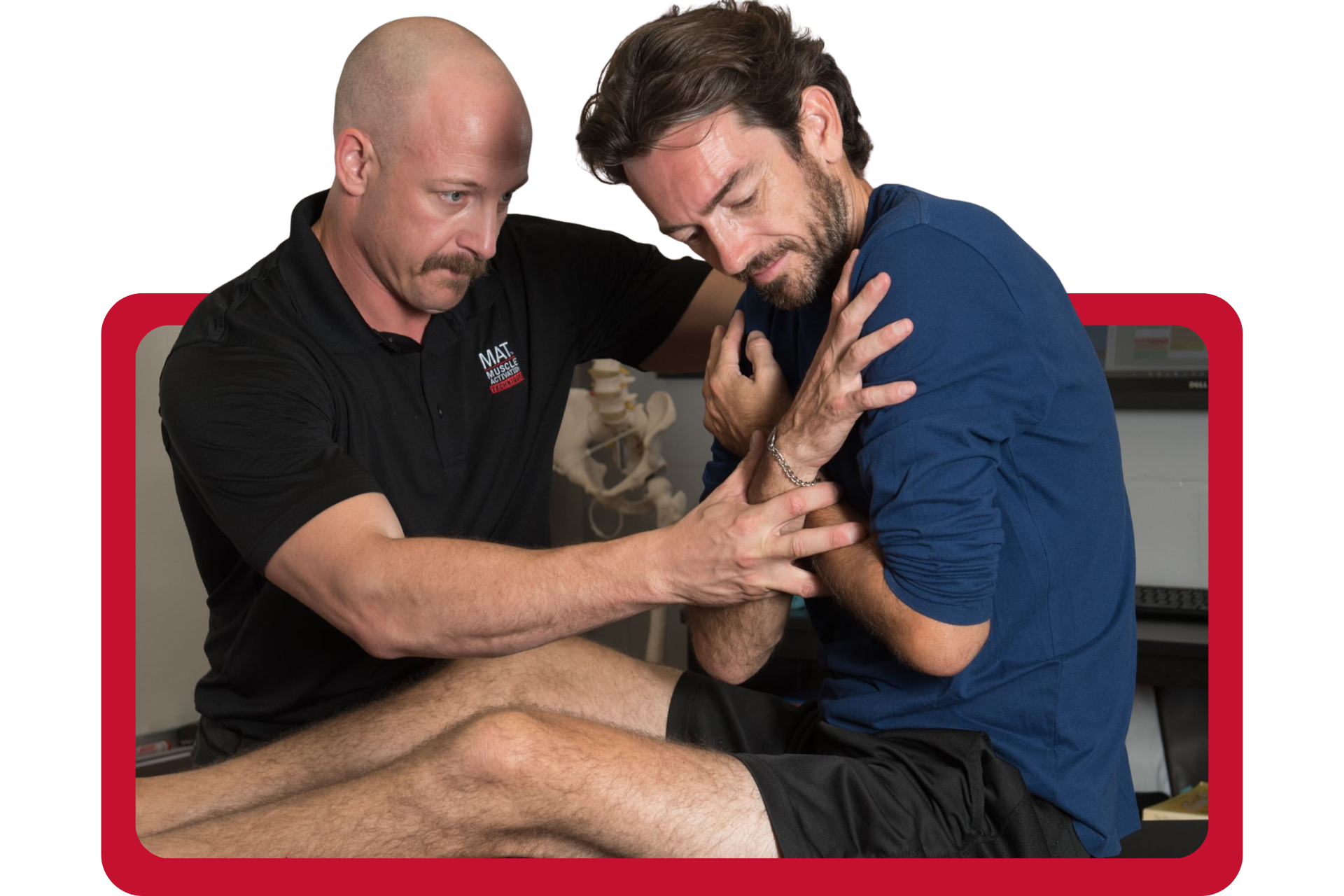
From there, I assess movement and joint function, test how specific muscles are contributing, address the weaknesses or inhibition we identify, and then reassess the same movements. You leave with a clearer explanation of what may be driving the compensation and specific work to reinforce the changes between sessions.
A muscle can test weak because it lacks strength, but it can also appear weak because the nervous system is not recruiting it effectively.
Traditional strengthening assumes the muscle can already participate correctly and simply needs more load. Muscle activation work first asks whether the muscle can contract when it is needed and help stabilize the joint. Once that communication and control improve, strengthening can be more productive.
Yes. Fitness-Tek can complement physical therapy, chiropractic care, massage therapy, medical treatment, and other forms of care when each provider is working within their own scope.
Those approaches may address diagnosis, rehabilitation, joint motion, pain, or soft-tissue tension. Fitness-Tek focuses on muscle activation, neuromuscular function, compensation, stability, and progressive strength. When appropriate, I encourage communication and collaboration with the client’s healthcare and wellness team.
Compare MAT® with physical therapy, massage therapy, and chiropractic care, then choose the next step that fits your situation.